
A Colissimo package can weigh less than five kilograms and still be refused at the counter. Weight is not the only criterion for acceptance: the size, shape, and even the bulkiness of the packaging come into play. This article compares the official Colissimo dimension thresholds in 2026, identifies borderline cases that lead to refusals, and details the concrete consequences of exceeding these limits.
Colissimo Dimensions 2026: Threshold Table by Destination

The format rules vary depending on whether the package is going to mainland France, overseas territories, or international destinations. The table below summarizes the main constraints.
| Criterion | Mainland France, Monaco, Andorra | Overseas | International |
|---|---|---|---|
| Maximum weight | 30 kg | 30 kg | 30 kg |
| Cumulative length + width + height | 200 cm | 200 cm | 200 cm |
| Longest side | 100 cm | 100 cm | 100 cm |
The limit of 30 kg and 200 cm cumulatively applies uniformly. However, the tolerance at drop-off points and post offices is not the same: a weighing machine in an agency also measures volume, whereas a commercial relay may not always have the same equipment.
Understanding the maximum size of a Colissimo package requires distinguishing between these two thresholds: the cumulative measurement of the three sides and the length of the longest side, which are two distinct constraints that must be satisfied simultaneously.
Package Refused Despite Compliant Dimensions: Common Causes
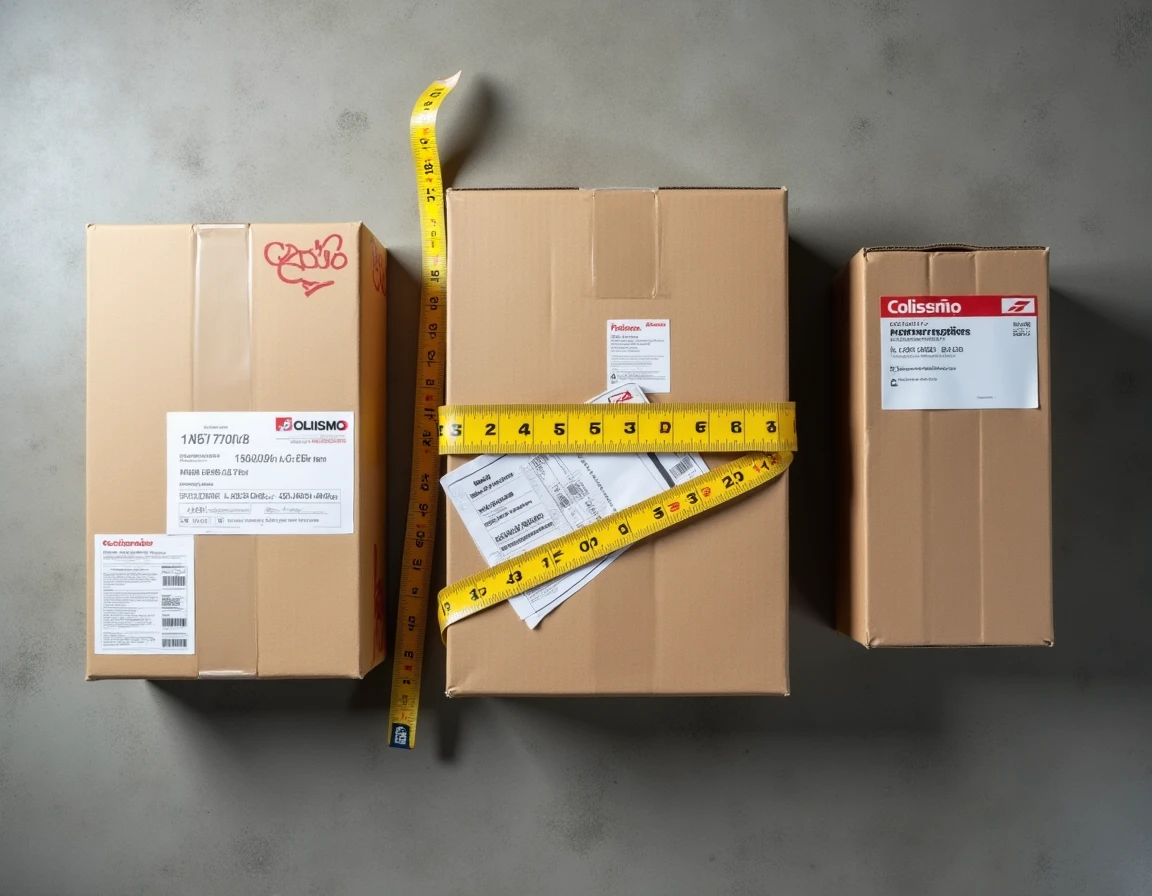
Competitors mainly focus on pricing. Cases of refusals at drop-off points are rarely documented. However, they occur regularly, even for packages whose theoretical dimensions comply with the thresholds.
Bulky Packaging and Actual Size Measurement
A box filled with bubble wrap or air cushions can bulge on its sides. The measurement is taken on the package as it presents itself, not on the flat dimensions of the empty box. A box that is 95 cm long that bulges a few centimeters in width exceeds the cumulative threshold without the sender realizing it.
The measurement is based on the closed package, not on the flat box. This is the most common cause of refusals for bulky shipments.
Irregular Shape and Non-Rectangular Objects
A tube, a soft bag, or an object wrapped in stretch film with protruding angles presents a different problem. The size is assessed based on the smallest rectangular box that would contain the object. A tube measuring 105 cm will be treated as a package whose longest side exceeds the limit, even if its diameter is modest.
- A soft box that deforms under the weight of its contents may see its dimensions increase by several centimeters between the home and the counter
- An improvised packaging (garbage bag, plastic wrap) does not guarantee any dimensional stability and is often refused for handling reasons
- Straps or handles that extend beyond the package are included in the measurement of the overall size
Discrepancy Between Prepaid Label and Actual Package
Online postage requires entering dimensions. If the package presented at the counter does not match the declared dimensions, the agent may refuse acceptance or apply an additional postage charge. A discrepancy of a few centimeters is enough to reclassify the package into a higher pricing tier.
Consequences of Exceeding Colissimo Dimensions
Exceeding the limits does not always manifest in the same way. Three scenarios arise, depending on the drop-off channel and the extent of the discrepancy.
Simple refusal at the drop-off point. The package is returned to the sender. This is the most common case at post offices equipped with a weighing-measuring machine. No fees are charged since the shipment does not enter the system.
Reclassification to another service. When the package exceeds Colissimo limits but remains within the scope of another service from the La Poste group, the agent may suggest a redirect. The rate changes, sometimes significantly.
The third case concerns packages dropped off at a relay point without strict control. The package enters the network and is then detected at the sorting center. It may then be returned to the sender, with additional delays and without a refund of the initial postage.
Measuring a Colissimo Package Accurately: Method and Pitfalls to Avoid
The reliability of the measurement relies on a few simple precautions, often overlooked.
Close and tape the package before measuring. An open or barely folded box gives dimensions lower than those of the package once secured and closed. Measure the widest point of each side, not the edge of the box.
- Use a rigid ruler, not a flexible sewing tape that conforms to the deformations of the box
- Add length, width, and height: if the total approaches 190 cm, allow for a margin for the bulkiness of the inner packaging
- For a cylindrical object, measure the length of the tube and the diameter: the equivalent rectangular size will be length x diameter x diameter
Below 180 cm cumulatively, the risk of refusal for dimensional excess becomes very low. Beyond 190 cm, every centimeter counts and depends on the tolerance of the agent or the machine.
Weight or Volume: The Criterion That Blocks First
For light and bulky shipments (duvets, camping gear, clothing boxes), it is almost always the size that poses a problem, not the weight. Conversely, for dense objects (books, tools, metal parts), the weight reaches the limit long before the dimensions.
The trap lies in the intermediate zone: a medium-sized package filled with bulky protective materials that weighs around fifteen kilograms. It remains under 30 kg, but the excessive packaging pushes it over 200 cm cumulatively. Excessive protective packaging is the primary cause of unintentional dimensional excess.
Adapting the box to the contents, rather than reusing a box that is too large filled with cushioning, remains the most reliable method to stay within limits. A properly sized box reduces both the risk of breakage and the risk of refusal at drop-off.