
Tightness after your morning cleanser, redness that appeared after switching creams, a skincare budget that keeps climbing with no visible results: these issues crop up in most overly complicated beauty routines.
The American Academy of Dermatology (AAD) confirms that using too many products can irritate the skin and drive up costs. Three daily steps are enough: cleanse, moisturize, and protect from the sun. Anything else should be tailored to your skin type and the signals it sends.
Minimal skincare routine: three products, no more
It’s easy to start piling on serums, essences, toners, oils, and facial mists. After a few weeks, the result can be overloaded skin that no longer knows what to absorb. Dermatologists recommend a simple three-step foundation.
- A gentle cleanser suited to your skin type: a foaming gel for oily skin, or a cleansing milk or oil for dry skin. Use it morning and evening without scrubbing.
- A moisturizer chosen for each area: a rich cream on dry areas and a lightweight gel on the T-zone if you have combination skin. The AAD recommends applying it while your skin is still damp to help lock in moisture.
- A broad-spectrum sunscreen with SPF 30 or higher, every day—even in winter and on cloudy days. Sun protection isn’t seasonal.
These three products meet almost all your skin’s needs. Any additions (vitamin C serum, exfoliant, retinol) should come later, one at a time. Watch how your skin responds for at least two weeks before introducing another product.
For a closer look at each step and product recommendations to suit your budget, Mode by S’s beauty advice offers practical routines for different skin types.

Signs of skin irritation: when to stop using a skincare product
A product that stings slightly the first time you apply it isn’t necessarily a problem. However, persistent redness, itching, or cracks are warning signs you shouldn’t ignore. The difference between an adjustment reaction and genuine irritation comes down to how long it lasts and how severe it is.
Normal reaction or irritation?
A mild tingling sensation that fades within a few minutes after applying an active ingredient such as glycolic acid can be normal. If it lasts more than half an hour or comes with red patches or a burning sensation, stop using the product immediately.
Dry skin is more likely to react to foaming cleansers containing sulfates. Oily skin can become irritated by overly rich creams that clog pores. Choosing skincare to suit your skin matters more than following a trend.
When to see a dermatologist
If symptoms persist after you stop using the suspected product, or if lesions appear (blisters or significant peeling), seek medical advice. Self-treating with skincare products has its limits, especially when layering several concentrated active ingredients without knowing whether they’re compatible.
Cosmetic ingredients and EU regulations on microplastics
Reading a cosmetic product label can feel like deciphering a prescription. But formulas are changing, and not just for marketing reasons. Regulation (EU) 2023/2055 introduces a phased restriction on synthetic polymer microparticles in cosmetics sold in Europe.
In practice, rinse-off products (shower gels, shampoos, scrubs) will be affected from October 17, 2027. Several categories of leave-on products (creams, serums, makeup) will follow from October 17, 2029. These microplastics were used as texturizers, film-forming agents, or carriers for pigments.
What this means for your bathroom cabinet
Over the next few years, the texture of some scrubs and foundations will change. Brands are already reformulating their products to replace polyethylene beads with biodegradable alternatives (apricot kernel powder, cellulose, silica). You can start spotting these changes on INCI ingredient lists: terms such as “polyethylene”, “acrylates copolymer”, or “nylon-12” indicate the presence of synthetic polymers.
Checking the INCI list before you buy takes thirty seconds and helps you choose formulas that already comply with upcoming restrictions. This is more useful than relying on “natural” or “clean” claims on the packaging, which have no regulatory definition.
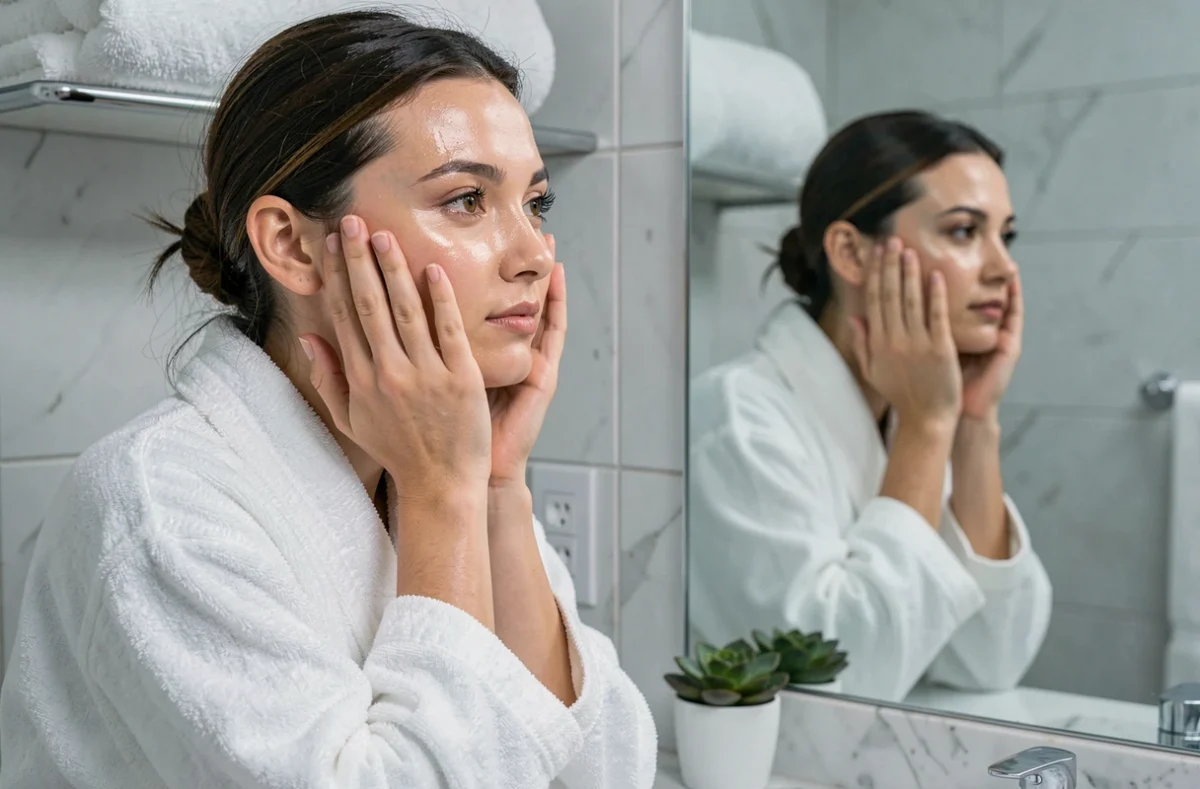
Skincare budget: build your routine without overspending
A product’s price doesn’t determine how well it works for your skin. An inexpensive pharmacy cleanser can work just as well as a premium-brand one. The AAD points out that skincare doesn’t have to be expensive to be effective.
The most cost-effective approach is to invest in two essentials: a good daily sunscreen and a moisturizer suited to your skin. Your cleanser can be a basic option. If you want to add an active ingredient (niacinamide, hyaluronic acid), choose just one in a standard size and use it up before trying another.
Multi-product sets and ten-step routines encourage overconsumption. Three or four carefully chosen products meet the real needs of most skin types. Anything else is a sensory pleasure, not a dermatological necessity.
Your skin doesn’t need more products; it needs the right ones. A short, consistent routine that pays attention to your skin’s signals delivers better results than constantly adding products and changing your skincare every month. A natural glow comes from consistency, not from the number of bottles on your shelf.