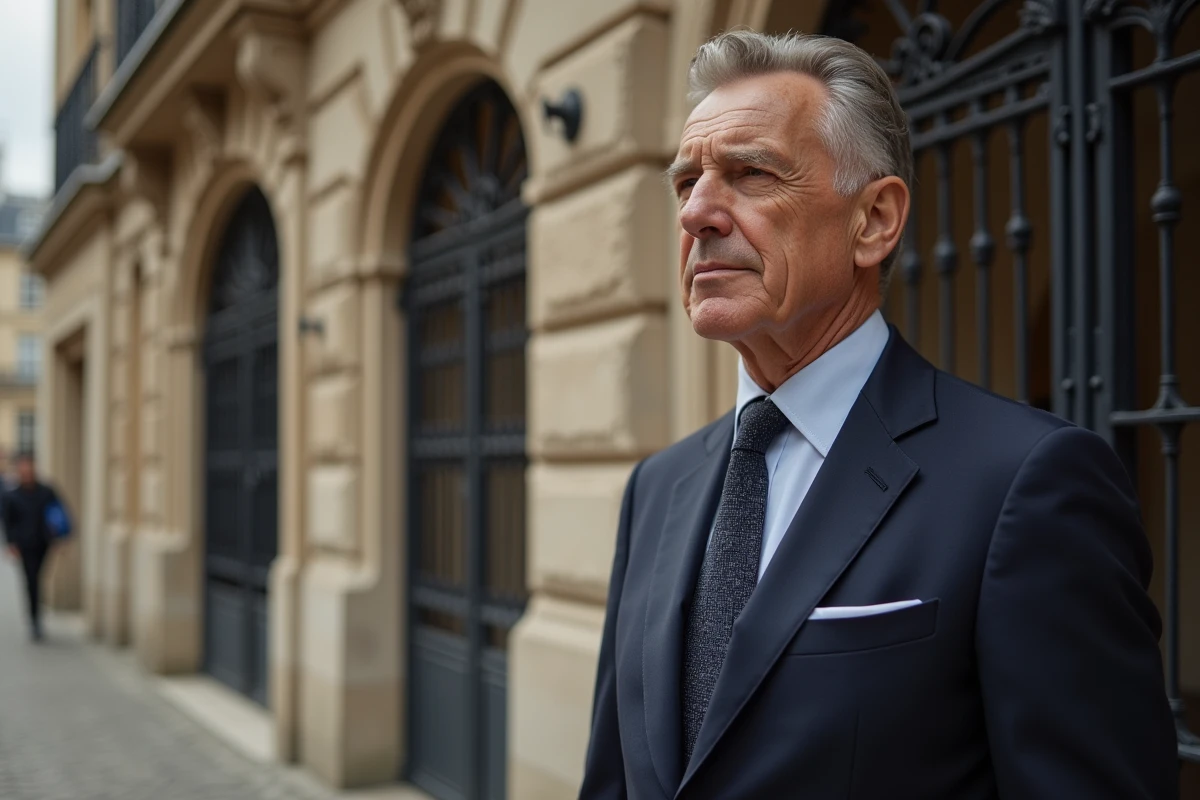
Alain Bauer is known for his analyses on security and criminology. His tenure as the head of the Grand Orient de France from 2000 to 2003 forged part of his public notoriety. His private life, however, remains a territory he protects with remarkable consistency, which regularly fuels curiosity and speculation.
Discretion about Alain Bauer’s private life and networks of Freemason influence
How does such a media figure manage to keep his marriage and family off the radar? The answer lies as much in a personal strategy as in an environment that facilitates this compartmentalization.
Alain Bauer served as Grand Master of the Grand Orient de France for three years. This Masonic obedience, the oldest in France, operates on a principle of confidentiality of exchanges between members. The connections forged in this context are not public, and the solidarities that arise from them remain difficult to document from the outside.
To delve deeper into the marriage and private life of Alain Bauer, one must accept navigating between verifiable facts and deliberately maintained gray areas.
This discretion is not trivial. It allows for a clear separation between the personal sphere and professional or associative networks. The result: his wife, family background, and the circumstances of his union remain largely absent from traditional journalistic databases.
Alain Bauer as a government consultant: when public and private life collide
Alain Bauer has advised several French political figures. His name appears in the circles of government officials, and his positions on security earn him regular invitations in the media.
This positioning creates tension. On one hand, he addresses topics that directly impact the country’s politics: law, security council, opinions on crime. On the other, he systematically refuses to discuss his marital or family life.
Accusations of favoritism and recurring controversies
The controversies surrounding Alain Bauer do not concern his marriage as such. They rather relate to how his Masonic or political connections may have favored his academic career or advisory roles.
- Questioning of his academic qualifications: criminologists have raised concerns about the methodological rigor of his work, with criticisms published in specialized academic journals.
- Appointments to advisory positions with ministers and presidents, perceived by some observers as linked to networks of influence rather than strictly scientific expertise.
- Alarmist predictions regarding the security of the Paris 2024 Olympics: feedback from field agents has labeled some of his alerts as exaggerated compared to operational reality.
These elements feed a permanent suspicion. The boundary between legitimate expertise and network influence remains blurred in his case.
Alain Bauer’s marriage: what we know and what is speculation
The information available about Alain Bauer’s marriage can be counted on one hand. His wife does not appear in the media. No couple photos circulate in the national press. This complete lack of visibility is in itself information.
In France, the protection of private life is a right guaranteed by law. The civil code strictly regulates the dissemination of personal information without consent. Alain Bauer uses this legal framework to his advantage, and nothing obliges him to expose his intimate sphere.
Why this opacity fuels rumors
The paradox is simple. The more a public figure locks access to their private life, the more the public assumes there is something to hide. In Alain Bauer’s case, discretion generates more questions than answers.
Rumors concern the identity of his wife, potential professional advantages linked to his family background, or protections obtained through his networks. None of these hypotheses have been substantiated by public evidence.
Academic criticisms and the credibility of the criminology expert
In recent years, criticisms regarding the scientific validity of Alain Bauer’s work have intensified. Several criminology researchers have pointed out methodological biases in his publications. These criticisms do not concern his private life but shed light on an aspect of the debate: does his legitimacy rest on knowledge or on network?
This question is not trivial. When a consultant influences a country’s security policy, the solidity of their analyses matters as much as their relationships. Alain Bauer combines both: direct access to political decision-makers (minister, president, council) and intellectual production contested by part of the scientific community.
This dual status makes reading his career more complex than a simple criminologist’s CV. The man is as much an influence strategist as an analyst, and it is precisely this mix that makes the boundary between his public and private life so porous, despite the appearance of compartmentalization.
Ultimately, Alain Bauer embodies a case study of the French public figure who masters their communication. His marriage remains a subject without documented answers. The controversies surrounding him relate less to his union than to the intertwining of expertise, politics, and Freemasonry, three spheres whose boundaries remain difficult to delineate.